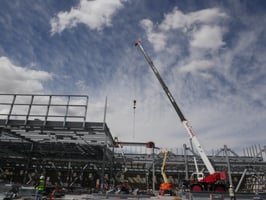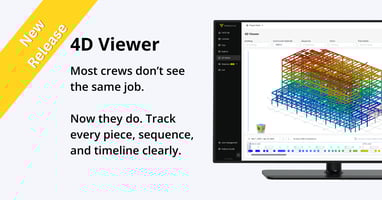
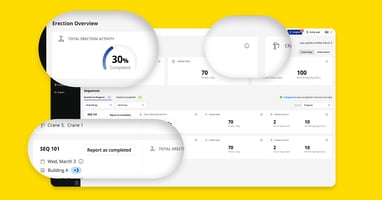
Keep your steel projects on track with a centralized Control Center that brings together the...
The 2026 North American Iron Workers IMPACT Conference in Las Vegas made one thing clear: structural steel is under pressure. Productivity expectations are rising. Workforce demographics are shifting. Artificial Intelligence is no longer theoretical.
It is here.
We attend and support the IMPACT Conference because this is where the real conversation happens. Not in tech echo chambers, not in owner boardrooms but on the floor with union leadership and contractors who are responsible for hanging steel.
Why We Support IMPACT
IMPACT is where union business managers, training coordinators, and contractor partners align on the future of the trade. If structural steel productivity tech is going to work, it has to work for ironworkers first.
Union leadership wants a competitive advantage. They want to protect members. To reach this goal requires production increase through obstacle removal, not just faster work.
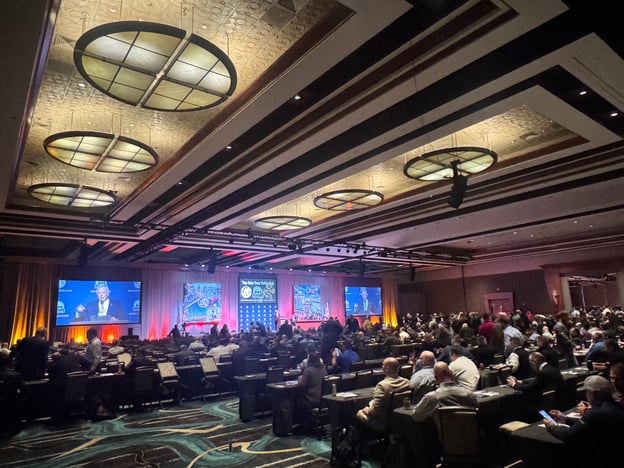
Versatile was not able to attend all the sessions but one we did attend that we'd like to share is from Mark Bridgers from Continuum Capital and we'd like to share some of his presentation throughout this post.
His dominant theme from the main stage was clear: AI must augment, not replace, the workforce.
Mark Bridgers from Continuum Capital framed it as a joint responsibility. Unions and contractors must lead adoption. AI and machine learning should increase output, expand capable workforce capacity, and accelerate personal performance. Not displace labor.
That distinction matters.
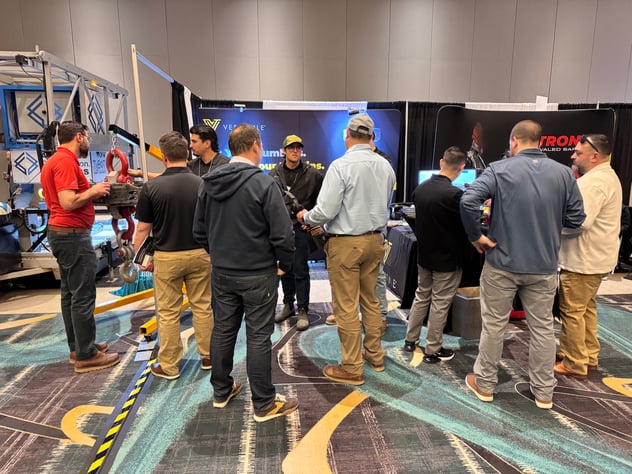
As Niko Suvorov, Versatile's VP of Sales, put it at our booth:
“At IMPACT, you feel a community where respect is earned through skill, grit, and the work you put in every day.”
That language from the stage resonated across the floor.
From Novice to Expert: What AI Actually Means in the Field
Bridger's presentation at IMPACT was titled “Novice to Expert: Applying AI Tools in the Field.”
The core idea was simple - AI shortens the path to mastery.
Without technology, skill development follows a long normal distribution curve. Years of on-the-job experience slowly move individuals from average to expert. With AI as a performance amplifier, lower-experience workers can perform closer to expert level faster.
That is not replacement. That is augmentation.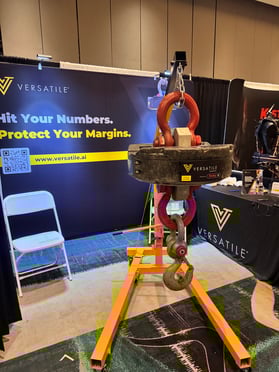
The presentation outlined three field applications:
- Production increase through output expansion.
- Individual and crew augmentation that expands capable workforce capacity.
- Accelerated personal performance, moving average performers toward superior performance.
For union business managers, this is workforce strategy. If you can raise the performance floor across a local, you increase competitiveness without increasing headcount.
What People Actually Asked at the Booth
The conversations at our booth were direct.
The first question was predictable.
“Is this a camera on the crane?”
No.
Crane data for steel erection is not about watching workers, it is about measuring structural steel progress, crane utilization, sequence flow, and production patterns. There is no facial recognition. No worker tracking. No biometric monitoring.
When people understood that distinction, they leaned in.
The second question was sharper.
“Who owns the data?”
Steel erectors are increasingly aware that data equals leverage. If progress data sits in an owner-controlled platform, the erector loses negotiating power. If it sits with the contractor, it becomes a defensive and offensive tool.
Union leaders understood this immediately. Data ownership protects both contractors and crews.
The third question was the one that mattered most.
“How does this help my raising gang?”
Versatile loves that question.
Structural steel erection is won or lost in the sequence. Small delays compound. Material readiness issues stall cranes. Unplanned stops erode margin. Many crews believe they are running tight. Until they see the gaps.
One executive told us:
“We thought we were tight. Then we saw where forty minutes a day were slipping between picks.”
That is a visibility issue.
Crane data for steel erection gives contractors evidence. Evidence of sequence readiness. Evidence of crane idle patterns. Evidence of recoverable time. Evidence that protects against finger-pointing.
That is what made people stop and listen.
Generation “Centaur” and the Steel Trade
Bridger's presentation also touched on the idea of “Generation Centaur.” Human plus AI. Judgment plus data speed. Experience plus pattern recognition.
The speaker traced productivity tools from the printing press to Pascal’s calculator to IBM defeating humans in chess, to ChatGPT placing knowledge in the hands of the masses.
Consider AI collaborative, a co-pilot.
In structural steel, that translates to:
- Human judgment on safety and sequence.
- Machine-speed analysis on production patterns.
- Consistent process applied across projects.
- Faster decision cycles in the field.
The ironworker does not disappear. The ironworker becomes amplified.
Christian Erickson, Versatile's Director of Marketing, summed it up this way:
“Steel erection has always been about skill and timing. Now it is also about visibility. If you can see production clearly, you can protect it.”
Union business managers who understand this dynamic are not resisting technology but rather how to shape it.
The Tripartite Opportunity
Another recurring theme from the stage was the tripartite opportunity. Owners, contractors, and labor working together.
The reality is that owners already demand more reporting. GCs already push schedule compression. The pressure is not going away.
Steel erectors have to make a choice: rely on external reporting tools controlled by others or adopt tools like Versatile that strengthens their own position.
Education is the bridge. If union locals understand that AI tools in the field increase production without demanding unsafe speed, the resistance drops. When crews see that technology removes obstacles instead of adding oversight, adoption accelerates.
WoodWorks and Mass Timber
Mass timber is growing in hybrid structures. As WoodWorks and other industry groups promote broader adoption, the question is how ironworkers will be involved.
Ironworkers already rig, fly, and place structural members with precision using crane coordination, sequence planning, safety under load, etc. Those skills transfer directly to hanging mass timber and hybrid assemblies.
There is a real opportunity for union ironworkers to lead in this space.
Jason Reynolds, Sr. Director, Construction Resource Services at WoodWorks said:
"The number of new commercial, multi-family, and institutional mass timber projects is increasing rapidly across North America. To meet this growing demand, the industry needs competent and safe erectors and workers to build these buildings. Ironworkers possess the crane, sequencing, rigging, and connecting skills for complex structures and this experience directly transfers to mass timber construction."
What This Means for 2026
With Union leadership asking how to lead AI integration and steel erectors asking whether data benefits the erector or only the owner, this IMPACT Conference felt strategic.
Structural steel productivity technology is no longer optional. The competitive advantage will belong to those who control production visibility, protect their data, and raise the performance floor across crews.
If you are a union business manager and want to educate your local on AI tools in the field, we are available.
If you are a steel erector evaluating new tech to protect your profits so you can measure what actually happens between picks, we are available.
Summary
At the 2026 IMPACT Conference, ironworkers and steel erectors focused on structural steel productivity technology, crane data for steel erection, and the responsible use of AI tools in the field. The message was clear: technology must augment the workforce, not replace it. Union leaders and contractors are looking for practical solutions that improve production, protect margins, and strengthen competitive advantage.
FAQ: Structural Steel Productivity and the IMPACT Conference
What is the IMPACT Conference for ironworkers?
The IMPACT Conference is the North American Iron Workers annual gathering focused on leadership, training, workforce strategy, and industry competitiveness.
How is AI used in structural steel erection?
AI is used to analyze crane data, production patterns, sequence flow, and project performance to improve structural steel productivity without replacing workers.
Does crane data technology monitor individual ironworkers?
Modern structural steel productivity technology focuses on crane and material movement, not individual worker surveillance.
Why does data ownership matter in steel erection?
Control of production data protects contractors during disputes, strengthens negotiation leverage, and ensures visibility remains in the hands of those performing the work.