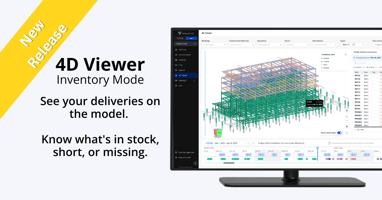
Your BOL Scans Now Show Up on the Steel Starting today, every BOL your crew scans paints the 4D...
Seeing Steel Work as It Happens: A Shift Toward 4D Visibility on Jobsites
On most steel projects, the issue is not a lack of information. It is a lack of shared visibility.
Project teams work across the field and office, relying on calls, photos, and reports to understand progress. These inputs provide pieces of the picture, but rarely a consistent view of what has actually been built.
As projects become more complex, that gap between data and understanding becomes harder to manage.
We heard this repeatedly from steel erectors and project teams. Different people were working from different versions of the same job, and decisions were being made without a clear view of reality.
So we asked a simple question: what would it look like if everyone could see the job the same way?
That led to a framework built around four things teams need to see clearly.
A Framework for Jobsite Visibility
1. Most Teams Aren’t Looking at the Same Job
Alignment breaks down when people are working from different views of progress.
Supers see one thing. PMs hear another. Executives get a summary. None of it fully lines up.
We heard that existing 3D tools weren’t helping. They were built for coordination, not for running the job.
So we focused on a model that reflects what’s actually happening in the field. Something simple enough to open and understand in seconds.
One job. One shared view.
2. Finding the Right Piece Shouldn’t Take Time
In the field, teams know exactly what they’re looking at.
In a model, that same piece can take minutes to find. Sometimes longer.
That gap slows everything down.
So we connected every element in the model to the information teams already use, including piece mark, design ID, and installation status. Instead of searching, users can isolate the exact component and move on.
We showed this to a project manager at a steel erection company and he said, “Wow, now when someone asks about a specific beam, I don’t go searching anymore. I can just pull it up and see it.”
3. If Something Is Off Early, It Repeats
Steel erection runs on sequence. When something slips, it rarely happens once.
If the first 500 pieces are off, the next 5,000 will be too.
Most tools don’t make that visible. They show plans, not patterns.
We heard that teams needed to see how work was actually unfolding, not how it was supposed to.
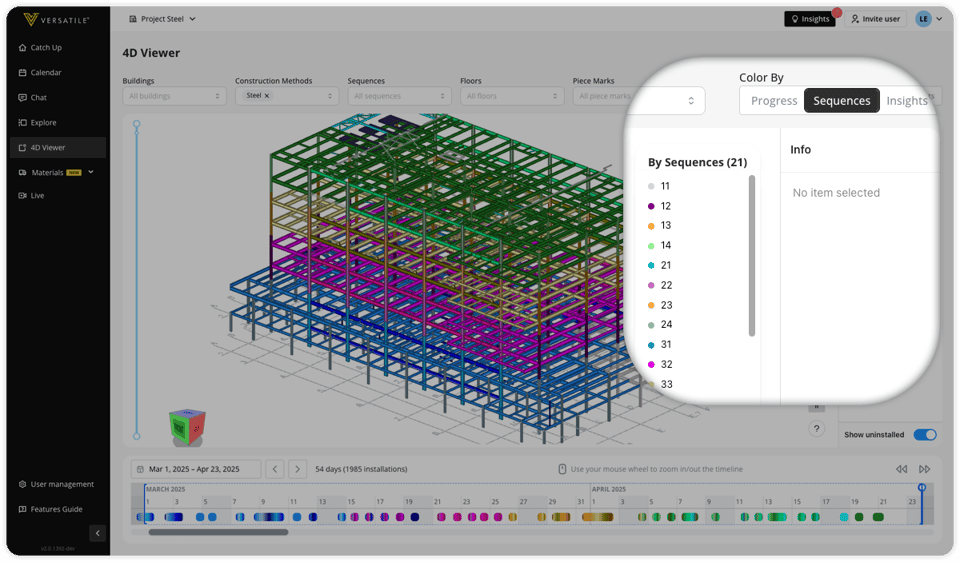
So we made sequence visible in the model. Teams can see what’s in progress, what’s missing, and where work is starting to drift.
That makes it possible to act early, before small issues spread.
4. Explaining the Past Shouldn’t Take Hours
Reconstructing what happened on a jobsite is still a manual process.
Reports, updates, and conversations all add context. But they don’t always align.
So teams spend time explaining instead of moving forward.
We heard that clearly.
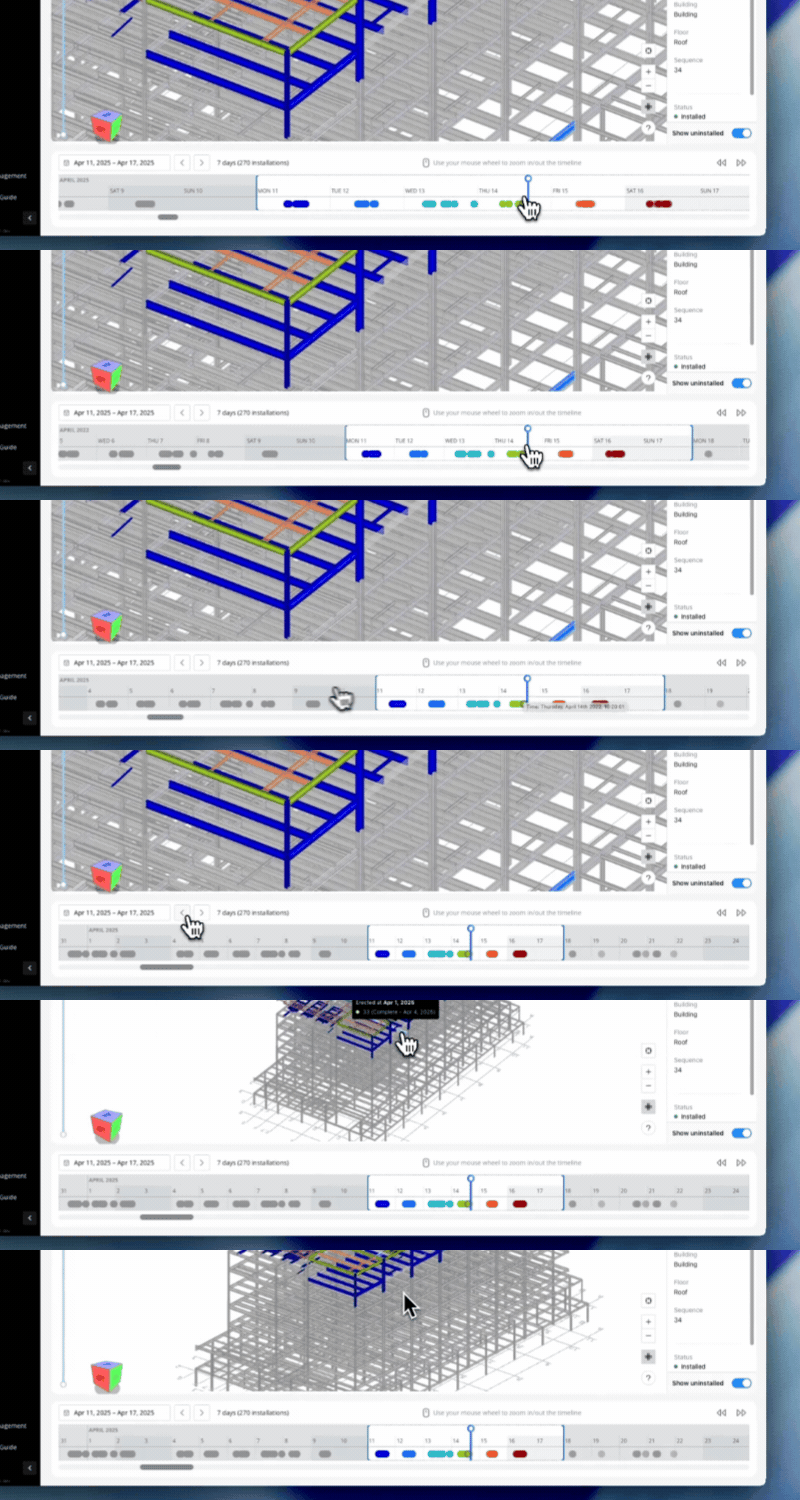
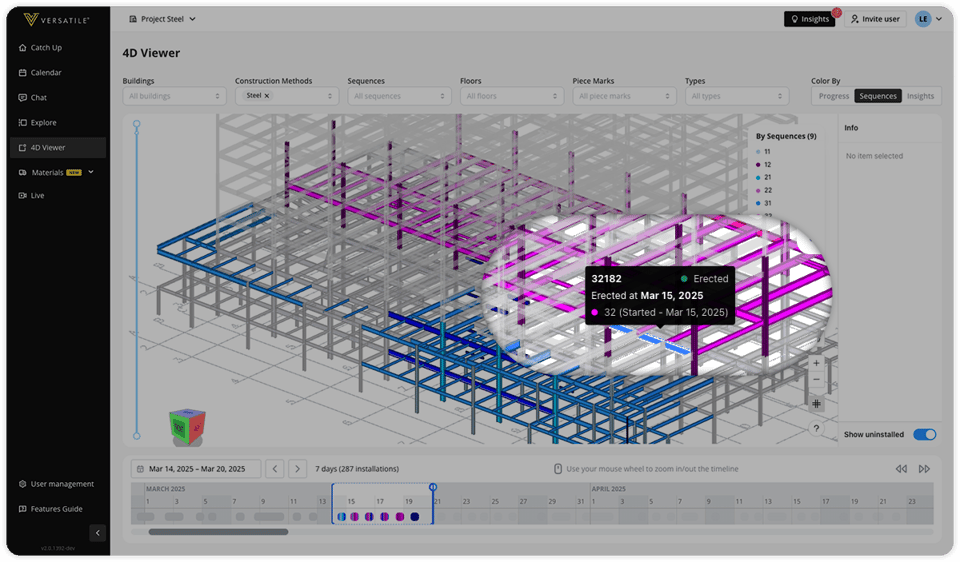
So we made it possible to move through the job over time. Pick a date. See what was built. Understand what changed.
No interpretation required.
“When questions come up, we don’t have to explain it the same way anymore. We can just show what happened and move forward," a data center super told us this during a recent demo of the feature.
Meet the 4D Viewer
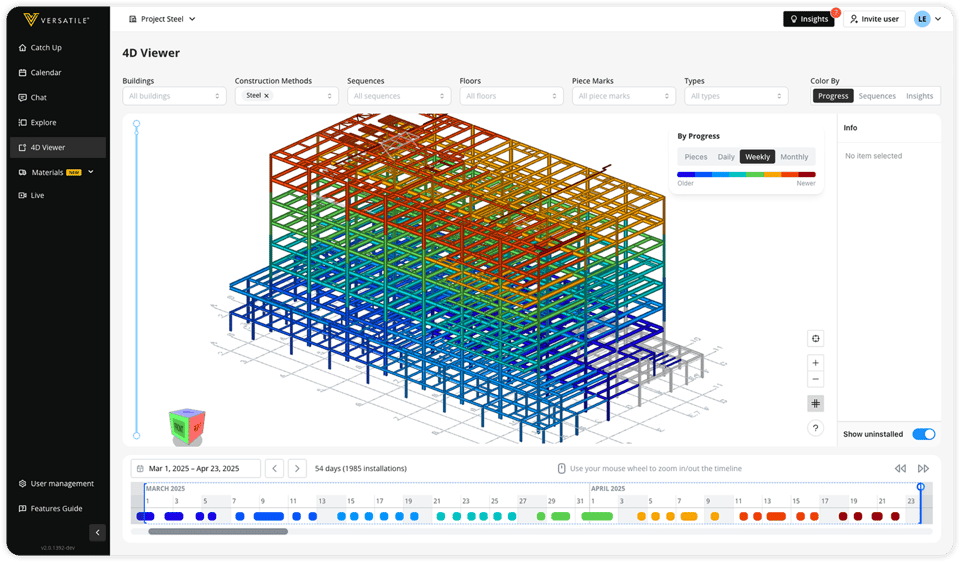
We built it to connect spatial context with time-based data so teams can see how a project is actually being built. The model updates automatically using production data collected from crane activity, eliminating manual updates.
Teams can open the model and understand progress immediately. No manual input. No chasing updates. You open the model and see the job as it’s been built.
As Niko Suvorov, VP of Sales at Versatile, explains: “The information has always been there. What’s changing is the ability to see it in a way everyone understands.”
When Everyone Sees the Same Thing, Conversations Change
When teams work from a shared view, conversations change.
We have seen that questions that once required multiple calls can now be answered directly in the model. Teams spend less time explaining and more time aligning.
This also improves communication with stakeholders who are not on site but still need a clear understanding of progress.
From Updates to Evidence
We also saw the need for a more reliable way to document what has been built.
So we made it possible to capture and share the model over time. Teams can use this visual record to support discussions around delays, sequencing, and performance.
“When you can show the job instead of describing it, the conversation changes,” Suvorov said.
A Shift in How Decisions Are Made
As more teams adopt this approach, decision-making begins to change.
Instead of relying on fragmented updates, teams can review a model that reflects the job as it has progressed. This leads to faster alignment and more informed decisions.
We did not set out to create another reporting tool. We set out to remove the gap between what is happening and what teams can see.
Looking Ahead
The move toward 4D visualization reflects a broader shift toward clarity and verification.
Rather than asking teams to input more data, we focused on capturing activity as it happens and making it easy to understand.
For steel erection, where sequence and timing matter, that clarity can influence both daily decisions and project outcomes.
The data is already there.
Now teams can see it.
Every day of the project, captured and accessible in seconds.
Faster Onboarding. Better Alignment. Stronger Decisions.
Bringing someone new onto a project is typically a slow process. It involves drawings, explanations, and a lot of time spent trying to understand what has already happened.
With the 4D Viewer, that process is dramatically faster.
A new project manager can scrub through the timeline, watch how the job progressed, and understand the current state of the project in minutes instead of days.
That level of clarity improves not just onboarding, but every conversation across the project.
The Difference Is Automatic
Most tools require someone to go into the field, assess progress, and manually update a system.
That process is slow, inconsistent, and often incomplete.
The 4D Viewer works differently.
It is powered by IoT-collected production data from the crane, which means the model updates automatically without requiring manual input from the field team.
The data is already there.
That is what makes this possible.
See the Job. Control the Outcome.
The 4D Viewer gives you that visibility.
Open the model.
Pick a date.
Look at the job.
Everything else becomes easier from there. Contact us to set up a 1:1 demo.